Digital Workers

Hire a finance and compliance team that does not take leave. Every role does a real job end to end in the systems you already run – and asks you about the things it should not decide alone.

7
finance and compliance roles
100
systems they work in
7
days to the first one working

Not a tool. A role.

Software you have to operate is another thing on your team's plate. A digital worker takes something off it.

A hired Automize digital worker: its role, what it runs on, and whether it is ready.
A hired Creditors Clerk: what it has run, what it is waiting on you for, and how much of it needed a person.

It owns the whole job

From the invoice landing in the inbox to the entry posted in the ledger and the exceptions on your desk – not one step of it, all of it.

It knows when to ask

A new supplier, an odd amount, a variance outside tolerance – it stops and brings it to you rather than guessing.

It works where you work

Your ledger, your bank, your payroll package – including the desktop ones that never got an API.

It reports for itself

Volume, straight-through rate, exceptions by reason, and how long work waits on you. You can measure it the way you measure a person.

The finance and compliance desk

Hire one, or the whole desk. Most firms start with the Bank & Reconciliation Clerk and add the Creditors Clerk once they trust it.

Billed in South African Rand. Prices are indicative of a typical engagement – volumes and the number of systems move them.

Want to try the reading part first? The document tools run the same extraction engine, self-serve and free for 25 pages a month.

How you hire one

1. Show it the job

We sit with whoever does the work today and map it – the systems, the rules, the exceptions, and the tolerances that decide when a human is needed.

2. Let it work alongside

For the first period it proposes and you approve, on your real data. It learns your coding, and you find out exactly where it is strong before anything runs unsupervised.

3. Supervise, do not operate

It runs on its own and brings you the exceptions. Your team reviews a queue instead of doing the capture – and the approvals stay wherever they sit today.
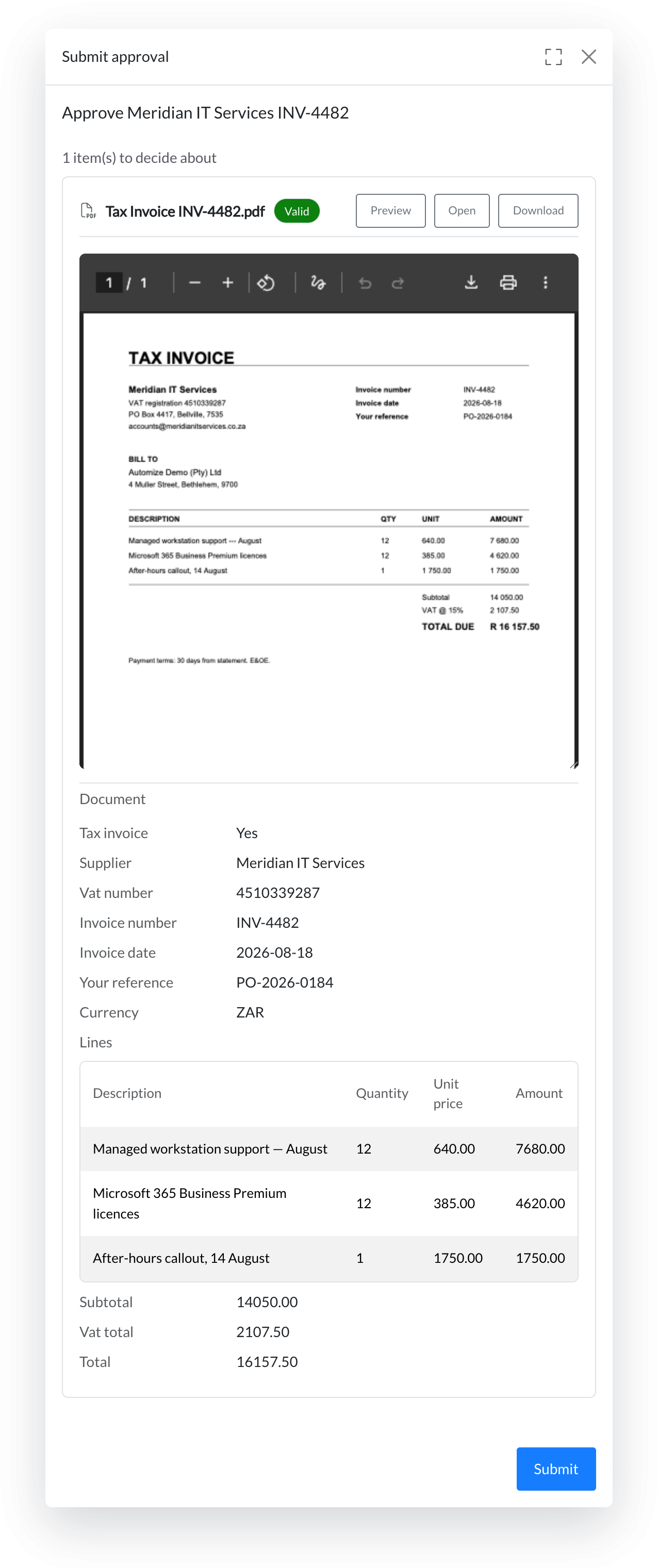
An Automize approval: the supplier invoice PDF beside the fields extracted from it, with approve and reject controls.
Working alongside, as your team sees it: the invoice it would not post alone, and the decision it is waiting on.

Built for accounting practices first

Nearly three-quarters of firms are turning away work they cannot staff. A digital worker is capacity you can add this month, priced the way you already bill.

One business

From R3,500 / month

One role, working in your own finance or compliance function, with a monthly volume envelope and per-document overage beyond it.

Practice plan

From R1,200 / client / month

One worker across your whole book, ten clients minimum, tiering down as you add more. Rebill it into your own fee and keep the margin.

Getting started

R6,000R15,000

Per role, per client. Mapping the job, connecting the systems, and running it alongside your team until it is trusted.

Billed in South African Rand. Prices are indicative of a typical engagement – volumes and the number of systems move them.

The systems they already work in

100 pre-built connections across the roles – ledgers, banks, payroll, document capture, identity and sanctions screening, e-signature, legal practice management, and the tools your clients send things through.

Browse every connector

Questions about digital workers

A finance or compliance role, delivered as software. It is not a chatbot and not a licence you have to learn – it does a named job end to end, works in the systems you already use, asks you about the things it should not decide alone, and reports what it did. You hire it the way you would hire a person, and you supervise it the same way.
It is built on it. Automize the platform is a builder – you design the process. A digital worker is the finished role: already designed, already connected, already knowing what a creditors clerk is supposed to do. If you want to build your own, the platform is still there.
It replaces the part of the job nobody enjoys – capture, coding, matching, chasing. What is left is the judgement, and that is the part clients actually pay for. Firms use this to take on more clients without hiring, not to cut the team they have.
Two of the roles are built for you rather than adapted to you. The Trust Account Clerk reconciles the trust account, allocates receipts to matters and proves trust creditors against the funds held – the reconciliation the Act asks for, not a bank reconciliation with a different account number. The FICA & Onboarding Clerk runs client onboarding, screening and re-screening. The same obligations fall on financial services providers, trust and company service providers and motor dealers, and it is the same worker in each – only your risk rules differ.
It should stop rather than guess, and everything it does is logged with the document and the reasoning attached. Anything filed with SARS, any payment run, any payroll, any transfer out of a trust account, and taking on a new client always waits for a named human to sign off. Those gates are permanent.
Xero, Sage Business Cloud, QuickBooks, Zoho Books, Wave, FreeAgent, SYSPRO, Odoo, NetSuite, SAP Business One, Dynamics 365, Tally and Wafeq through their APIs – and desktop packages like Sage Pastel through their own screens, which is where most South African small businesses actually are.
Seven days for the first role, through the 7-Day Proof-of-Value: we build it against your real data at a fixed price and hand back an ROI report. Adding a second role to a client already running one takes days, not weeks.
Documents, credentials and client financial data stay on the machine the bot runs on and are never sent to us. Automize holds the process definition and the execution logs, on AWS in Ireland.

Start with one role, on one client

Seven days, a fixed price, and an ROI report at the end of it.